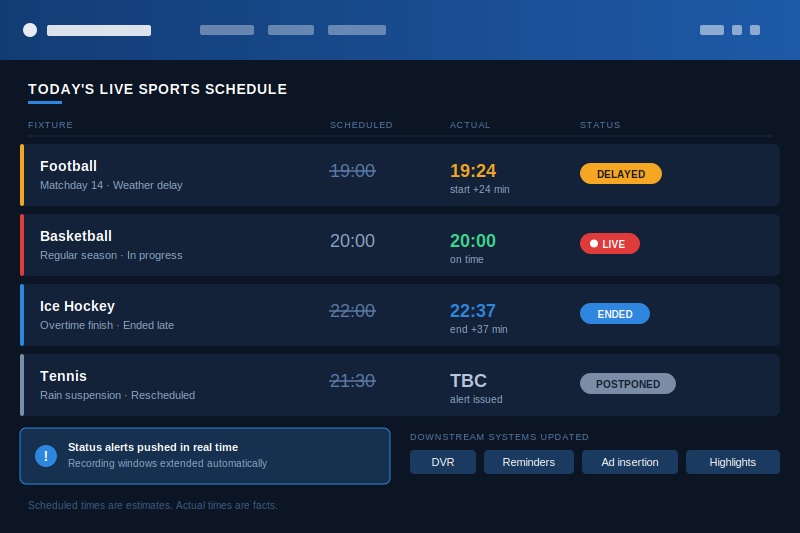
A scheduled kick-off time is a prediction, not a fact. Games are delayed by weather. Matches run into overtime, extra time, and shootouts. Broadcasts join in progress, move to a secondary channel, or get postponed hours before the first whistle. Yet most scheduling data treats the announced start time as the single source of truth, and every downstream system inherits that assumption.
For broadcasters and OTT platforms, that gap between scheduled time and actual time is where operational problems begin.
The Cost of a Schedule That Does Not Update
The consequences are familiar to anyone who has worked in live sports distribution. Recordings stop before the game ends. Programming scheduled after an event gets cut off or joined late. Viewers who set a reminder for a delayed fixture arrive to an empty stream.
These are not edge cases. Cloud DVR services cut off overtime finishes because the recording window was set from the scheduled end time. Shows following a sporting event are captured only partially because the event overran and nothing told the system. The common cause in each case is the same: the system knew when the game was supposed to start and end, but never learned when it actually did.
For an OTT platform, the stakes are higher than a single missed recording. Live sport is increasingly the reason subscribers sign up and the reason they stay. A stream that begins late, a countdown timer that expired twenty minutes ago, or a push notification announcing a game that has already finished all erode confidence in the platform itself.
What Continuous Schedule Tracking Actually Means
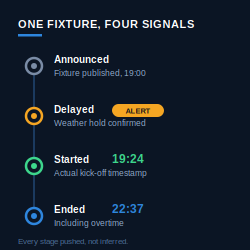
Continuous schedule t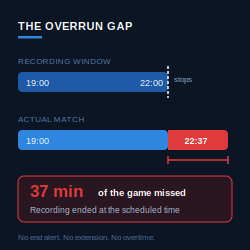 racking means the schedule is a live record that keeps updating, rather than a fixture list published once and left alone. In practice it spans four stages.
• Initial announcement: The fixture enters the system as soon as the competition publishes it, with competition, participants, venue, and provisional timing attached.
• Live status alerts: Postponements, cancellations, venue changes, and channel changes are pushed as they are confirmed, not discovered later through reconciliation.
• Actual start timestamp: A confirmed record of when play genuinely began, delivered as an alert rather than inferred from the scheduled time.
• Actual end timestamp: A confirmed record of when the event concluded, including overtime, extra time, penalties, and weather suspensions.
Almost every provider supplies the scheduled time. Far fewer supply the actual time as a reliable, real-time signal. Yet automated systems need actual timestamps because they are the only values that describe what really happened.
Why Timestamps Matter More in an Automated Workflow
This becomes more consequential as broadcast and OTT operations automate. When a human producer ran the schedule, a person noticed the overrun and adjusted. In an automated pipeline, nothing notices unless the data says so.
Accurate start and end timestamps are what let recording windows, countdown timers, ad insertion, archive indexing, and automated highlights anchor themselves to real events rather than projected ones. Frame-level indexing of a match is far less useful if the clipping process began from a scheduled time that was twenty minutes wrong.
The same applies to advertising. Dynamic ad insertion and inventory pricing depend on knowing when live content is genuinely live. An overrun that goes unreported means inventory sold against a window that no longer reflects what is on screen.
Across broadcast, OTT, and AI workflow platforms, the underlying benefit is the same. The schedule stops being a guess that humans correct after the fact, and becomes a live signal that systems can act on without supervision.
 The DSG Advantage: Schedules Built for Live Operations
Delivering schedule data that holds up under live conditions requires both breadth of coverage and reliability of delivery.
• Extensive Global Coverage: More than 70 sports and over 900 international competitions, structured under a consistent data model.
• Consistent, Reliable Delivery: Low-latency feeds backed by 98.9% uptime, so status changes reach downstream systems when they matter.
• Modular API Structure: Take the schedule and status layers you need, and extend into deeper statistical and performance feeds as requirements grow.
• Standardized Across Competitions: Consistent event and status definitions that hold their meaning across sports, regions, and delivery formats.
• Integration Support: Clear documentation and developer support for platforms of any scale.
Building Schedules That Reflect Reality
Live sport is unpredictable by nature, and no data feed will change that. What data can change is how quickly and reliably the rest of the system finds out. As broadcasters and OTT platforms automate more of the distribution chain, the gap between a scheduled time and an actual time stops being a minor inconvenience and becomes a direct operational cost. The platforms best positioned for that shift are the ones treating schedule data as a live signal rather than a fixed reference.