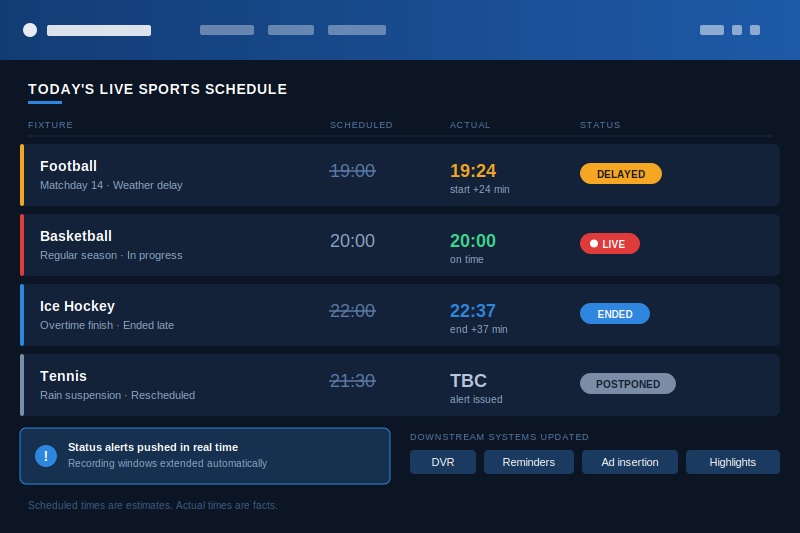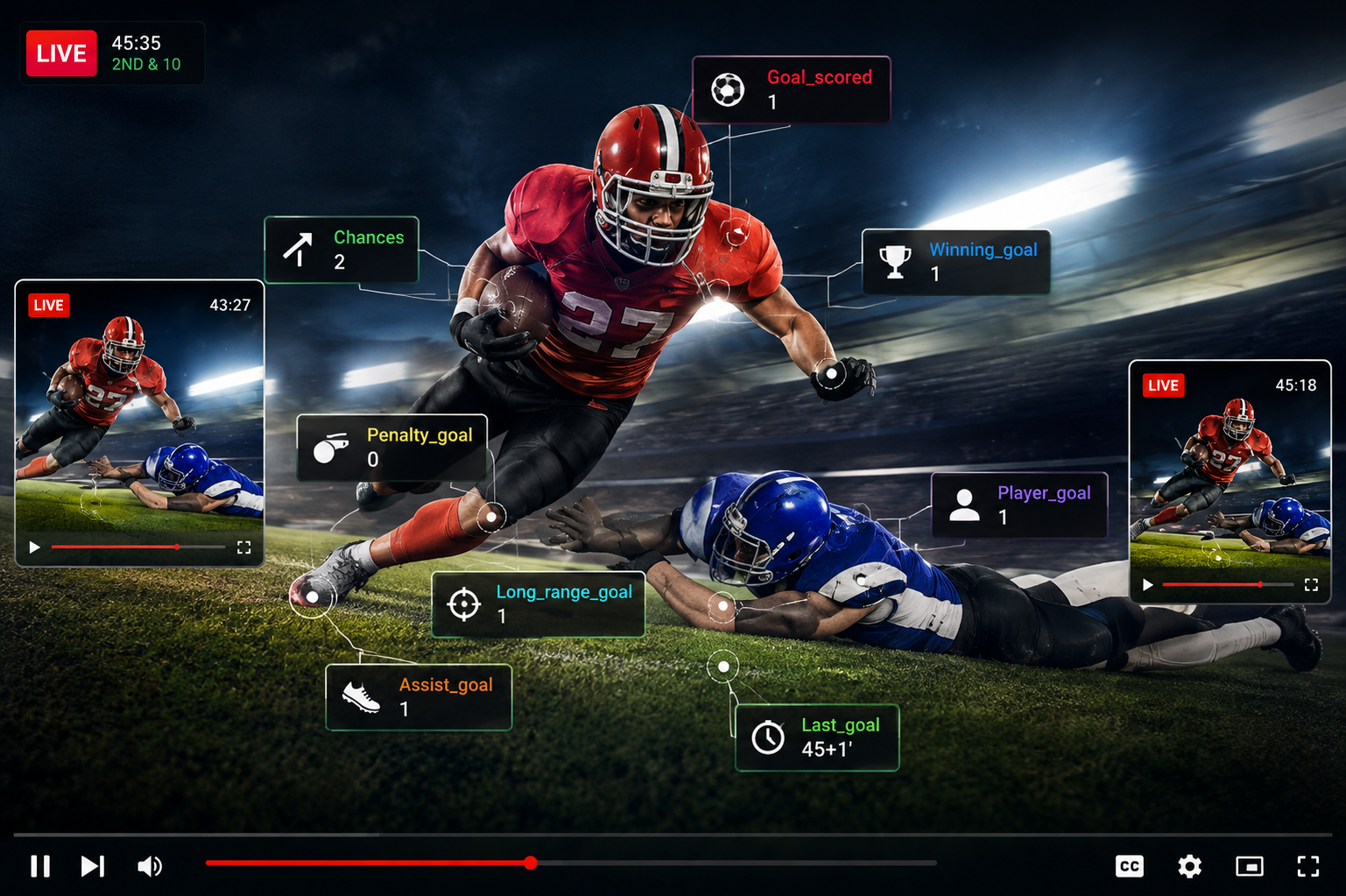
Every match now produces an avalanche of data. Computer vision rigs capture thousands of positional data points per player per second, and every pass, tackle, shot, and substitution is logged the moment it happens. By most measures, the sports industry has already solved the problem of collecting data.
What it hasn't solved is the problem underneath it: turning that raw flood of numbers into something a machine, or a person, can actually understand, trust, and act on in real time. That is a metadata problem, and solving it requires infrastructure, not just algorithms. The bottleneck in sports AI is no longer data capture. It is the metadata layer that makes captured data usable.
Data Without Metadata Is Just Noise
Sports metadata is the descriptive layer applied to raw sports data that identifies what each data point actually represents: which player, which team, which competition, which moment in the match, and which type of action. Raw tracking data records that an object moved from one coordinate to another. Metadata records that a specific player completed a pass to a teammate in the 63rd minute of a specific fixture. Without that layer, sports data cannot be searched, joined across sources, or used to power automated products.
The trouble is that most organisations generate this metadata inconsistently. Feeds arrive from different vendors with different taxonomies. Player names do not match across systems. An assist in one data set is not defined the same way in another. Multiply that across leagues, sports, and languages, and the result is what most rights holders and media partners struggle with today: siloed data that technically exists but is not synchronized, standardized, or ready to power anything automatically.
 Where AI Infrastructure Comes In
AI models are only as good as the metadata feeding them, and metadata at sports scale cannot be maintained by hand. This is where dedicated AI infrastructure, meaning the full pipeline rather than a single model, begins to matter.
• Automated entity resolution: Machine learning models that recognize a player, team, or venue as the same entity across feeds, languages, and historical seasons, even when names, spellings, or IDs do not match.
• Real-time event tagging: Computer vision and machine learning working together to convert raw tracking data into sport-specific language such as a tackle, an offside, or a power play, fast enough to be useful mid-broadcast.
• Taxonomy and schema management: A consistent classification layer sitting underneath every sport and league, so that a goal or a foul means the same thing whether it feeds a betting engine or a fan-facing app.
• Synchronization layers: Infrastructure that keeps live data, historical data, and third-party feeds aligned, so nothing arrives out of order or contradicts itself downstream.
This work rarely gets attention in product demos or marketing decks. But it determines whether AI-driven products such as personalized highlights, live win-probability models, automated commentary, and in-play betting odds work reliably at scale, or fall apart the moment two data sources disagree.
What Good Metadata Infrastructure Unlocks
Get this layer right and the downstream possibilities multiply quickly. Media and broadcast platforms gain automated highlight generation and graphics that pull the correct player and statistic instantly, without manual tagging. Betting operators get odds and in-play markets that update off a clean, consistent event stream instead of reconciling conflicting feeds. Fantasy platforms get scoring engines that stay accurate across leagues and rule sets because the underlying event definitions are standardized. And fan-facing products get personalization engines and AR overlays that can trust the data they are built on rather than compensating for gaps.
In other words, the AI on the surface is only as trustworthy as the metadata infrastructure running underneath it.
The DSG Advantage: Data Built to Be AI-Ready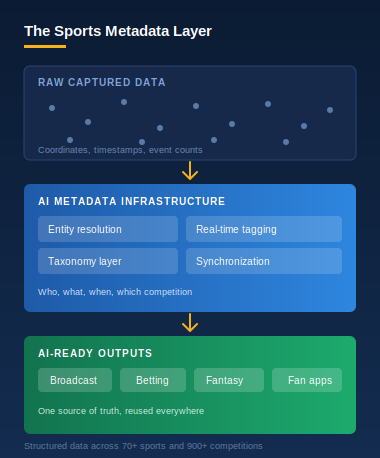
Structuring sports data consistently at global scale is precisely the problem Data Sports Group is built to solve.
• Broad Global Coverage: DSG covers more than 70 sports and over 900 international competitions, structured under a consistent data model.
• Scalable and Modular APIs: Take only the data layers you need, from core scoring through to deeper performance and analytical feeds.
• Dependable, Quick Feeds: Low-latency delivery backed by 99.99% uptime, so downstream systems receive events in the order and timeframe they expect.
• Standardized Across Sports and Languages: Consistent event definitions that hold their meaning across competitions, regions, and delivery formats.
• Easy Integration: Comprehensive documentation and developer support designed for both startups and large enterprises.
Building the Backbone
The sports organizations pulling ahead right now are not necessarily the ones with the flashiest AI features. They are the ones that invested early in consistent taxonomies, synchronized feeds, and metadata pipelines built to scale across sports and languages from the start.
As AI moves deeper into broadcast, betting, and fan engagement, the competitive question shifts from what a model can do to whether the data underneath it can be trusted. Before AI can reliably power the fan experience, it needs a metadata foundation built for that purpose, and choosing the right data partner is what makes that foundation possible.