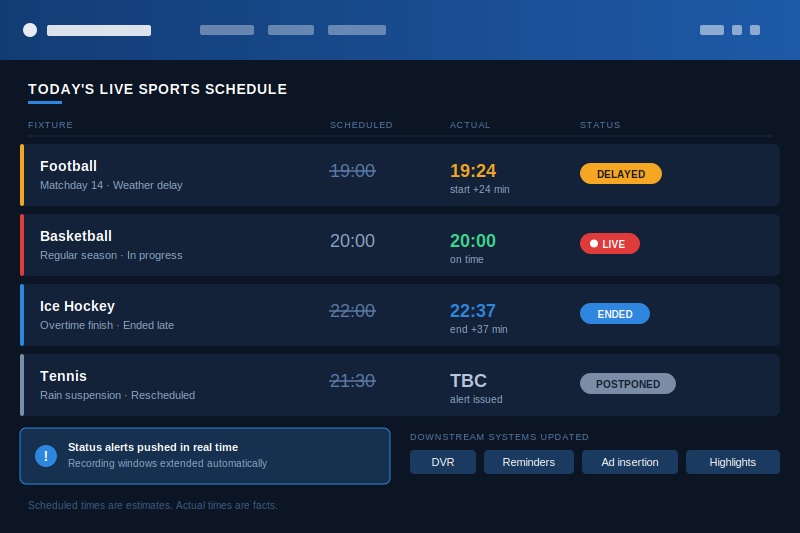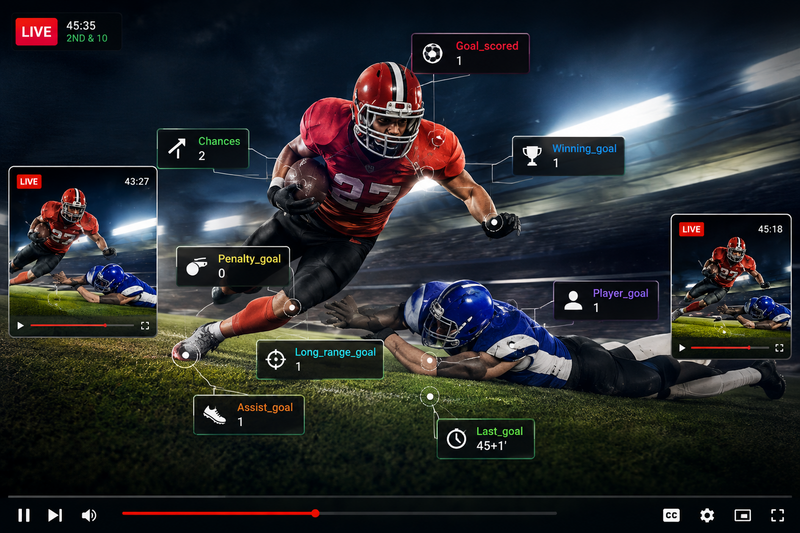
Only one intangible but crucial component powers internet betting, fantasy gaming, fan interaction, and sports broadcasting: the sports data feed. Knowing how a real-time sports data feed operates demonstrates the complexity and speed of today's digital sports ecosystem, which is crucial in an era where fans demand instant access to data-rich material. The use of live data is nothing short of amazing, ranging from goal notifications sent out seconds after the ball crosses the line to real-time sports updates on player substitutions, corner kicks, or injury time statistics. However, how precisely does this real-time data get to your screen from the field?
Let's examine in more detail the live statistics workflow and how companies such as Data Sports Group (DSG) enable it to happen globally, promptly, and precisely.
Breaking Down Real-Time Sports Data Feed
Player movements, ball placements, scores, fouls, time stamps, and other information are generated every second during a live game. This information is gathered by a sports data feed, which then converts it into structured data that platforms, broadcasters, and applications may use. Data gathering is the initial stage of the live statistics pipeline. This can be done automatically by AI-powered systems that use computer vision and tracking technologies, or manually by trained scouts stationed at stadiums. At this point, accuracy is crucial since inaccuracy and delay might ruin the user experience.
After that, advanced backend algorithms are used to validate and organize the data. After being verified, information goes into a real-time feed system and is dispersed to a number of destinations, including digital scoreboards, sports applications, media publications, and bookmakers.
Real-Time Sports Data: Accuracy and Speed Are Key
Milliseconds may make all the difference in sports. An ultra-low latency infrastructure is therefore necessary for the delivery of real-time sports data. To guarantee that viewers receive real-time sports updates in as little as two to five seconds, for instance, when a football player scores a goal, the event is recorded and processed almost instantly.
 Data Sports Group uses edge computing and cloud-based solutions to cut down on transmission delays. Our multi-layered validation systems ensure that errors are caught and corrected in real-time, maintaining data integrity across all consumer touchpoints. For live betting and fantasy systems, where even a 5-second lag can affect odds, game bets, and user confidence, this speed and dependability are extremely important.
Workflow for Live Stats: From Launch to Dashboard
Here is a condensed chronology of what transpires during a live sporting event to help you better grasp the live stats workflow:
1. Data Capture: Sensors, vision systems, or data scouts are used to record on-field activities.
2. Data Verification: Accuracy is guaranteed by many validation stages.
3. Data Structuring: Timecodes are applied to events, and they are classified (e.g., passes, fouls, substitutions).
4. Data Delivery: All registered platforms receive the structured data via APIs.
5. Visualization: Dashboards, widgets, and real-time visuals are some of the ways platforms present the data.
Throughout the tournament, this procedure is repeated every second, producing hundreds of data points for each match that are analyzed and sent instantly.
The Reasons Sports Businesses Depend on Data Sports Group
 Selecting the appropriate supplier is more crucial than ever as data is now the currency of digital sports engagement. With its unparalleled precision, worldwide reach, and real-time delivery rates, Data Sports Group is unique. DSG provides end-to-end assistance whether you're a broadcaster seeking smooth integration of real-time sports updates, a betting platform requiring minute-by-minute odds recalculations, or a fantasy game software requiring access to live statistical processes for point computations. Additionally, DSG's data feeds are easily integrated and customisable, and cover hundreds of sports and leagues globally, providing your platform with the accuracy and agility required in the fiercely competitive world of today.
The Use of Real-Time Sports Data for Business
Real-time sports data has enormous financial value in addition to being a technological marvel.
1. Viewer Retention: Long-term audience engagement is maintained with rich, real-time data.
2. Monetization: More sponsor activations and ad impressions are made possible by real-time information.
3. Operational Efficiency: Manual dependencies are decreased by automated data flows.
4. Competitive Edge: Having immediate access to data keeps you one step ahead of your competitors.
For this reason, purchasing a premium sports data feed like DSG's is a front-end growth strategy rather than only a back-end decision.
Conclusion
Every in-game alert, score ticker, and fantasy update is powered by an advanced live statistics process that runs incredibly fast and accurately. Not only are real-time sports updates improving the spectator experience, but they are also completely changing it. Sports platforms may access a reliable, accurate, and scalable data infrastructure through Data Sports Group, which powers anything from predictive analytics to live commentary. It's time to collaborate with a supplier that is knowledgeable in the art and science of real-time sports data if you want your sports business to succeed in this real-time age. DSG is prepared to drive your next action. Get in touch with our team to get a customized quote for your business.