As we head toward a future dominated by technology, the sports industry is changing at an exponential rate. In the sports sector, statistical data has always been crucial, but one particular technology has greatly affected audience engagement-AI. In this blog, we will be discussing the impact of artificial intelligence and sports data analytics on the sports sector.
Artificial intelligence has drastically changed how we watch and evaluate sports during the last 20 years. The use of AI and ML in sports is improving the game for players, broadcasters, sponsors, and, finally, fans who can get real-time information. One of the main advantages of artificial intelligence in sports is its critical role in sports forecasting, which enables a well-informed decision-making process. With the use of sensors, wearables, and monitoring devices, teams can now access real-time data and analyze player performance indicators more thoroughly than in the past.
 Imagine a world in which the secrets of peak physical capability are discovered by painstakingly analyzing every stride, every heartbeat, and every movement. Increasing the intensity of competition both on and off the field is the main goal of artificial intelligence in the sports sector. In some domains, artificial intelligence and machine learning have made a significant impact on the sports industry.
Here are the top applications of AI in the sports industry today:
Finding and recruiting the right talent: The process of finding and acquiring talent is complex, involving many different elements like biomechanics, player performance evaluation, and player recruitment. When evaluating an athlete's physical prowess and pace, biomechanics is a vital tool for spotting prospective ability. Player performance measurement, which entails methodically assessing players' talents, skills, and general performance to determine their appropriateness for recruiting, is aided by the use of IoT in sports.
Umpire assistance: A wide range of elements are included in game analytics, which helps with the general comprehension and examination of sporting events. Umpire assistance, which entails employing technology to help umpires make accurate choices during matches, is one use of artificial intelligence (AI) in sports analytics. Ball tracking systems, which follow the movement and trajectory of the ball in real-time, are among the greatest illustrations of this.
Insightful data that elevates team performance: The study of match events, which includes looking at different game elements like goals, fouls, and substitutions to get insights on team performance and tactics, is another component. Large-scale data analysis is made possible by the capability of AI algorithms, which aid in forecasting outcomes and offer insights for sports bettors.
Real live data feeds lead the way: Application of AI and Data Analytics also allows us to explore the capabilities and power of real-time live data feeds. With the use of sensors, and wearable tech, teams and coaches can keep a strict eye on the player metrics. It allows coaches to make instant strategic adjustments that can optimize team performance without risking players' health.
Forecasting Through Modeling: AI systems use predictive modeling to forecast results as well. These models may predict player injuries by using biometrics, external variables, and historical data. This helps with the creation of injury prevention strategies. They aid in strategy planning by simulating game scenarios as well.
Enhancement of Strategy: An opponent's perspective can now be included in AI-powered analysis. Teams that examine opponent data to find trends and patterns might develop more effective game strategies. During games, AI programs suggest the optimal lineup combinations and make tactical modifications in real-time.
 Fan Engagement Enhances with Immersive Experience
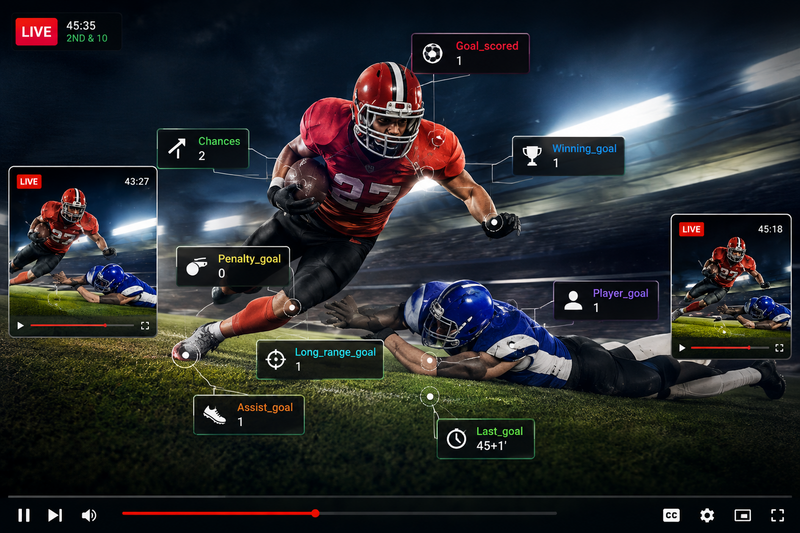
Fan engagement is being revolutionized by AI-driven analytics. Gaining insight into the tastes and behaviors of fans may help you customize promotions, content, and interactions. This particular tactic enhances fan connections and promotes involvement and loyalty. Also, AI-enhanced broadcasts improve the viewing experience for viewers with inventive camera angles and augmented reality overlays. For fans seeking a higher degree of interaction, virtual reality, and gamified elements offer dynamic, immersive experiences.
What does the future hold?
Competition has already significantly risen thanks to AI. It puts everything in the hands of game strategists, sports corporations, advertisers, franchise owners, and spectators with efficient sensors and algorithms. Businesses are expected to invest in AI development services for sports application development given the wide range of implementations. The combination of AI and sports is changing corporate norms and spurring innovation in the field.
Sports companies are better able to recognize and attract elite talent now that they have access to AI's capability, which will eventually shape sports as we know it in the future. The sports sector has countless opportunities for additional developments as long as technology keeps evolving with Data Sports Group you can too take advantage of the best sports data feed and elevate your platform. Get in touch with our team to know how.