In the world where sports and data have converged intricately let's unlock the strategies and innovations employed by betting companies as they harness the power of advanced sports data. Sports betting is no longer just based on intuition or luck, the industry is evolving continuously forcing sports betting companies to step up their game and enhance their offerings using sports analytics to lure more bettors.
Sports Betting's Evolution
The growth of sports betting can be seen from its basic beginnings to the sophisticated betting world we know today. The business, which was once limited to local bookies and primitive odds-making, has embraced the internet era completely. Betting has now become a global phenomenon because of online platforms and mobile betting applications. The true shift, however, is in how betting firms employ modern sports data to remain ahead of the curve and give unique services to their customers.
 To evaluate huge volumes of data and complex algorithms, advanced statistical models are now deployed by betting companies, which enables them to provide important insights on teams, players, and the general dynamics of sporting events. From intricate analytics to real-time insights, these companies leverage data-driven insights to redefine the game and elevate the betting experience for players.
Let’s explore further how cutting-edge technology is used by betting companies to craft reliable betting odds.
Data Analytics' Importance in Sports Betting
At its foundation, sports analytics comprises obtaining and analyzing relevant historical facts that can provide a team or individual with a competitive advantage. This data includes a variety of elements, such as player statistics, team performance measures, previous match outcomes, and external circumstances that can affect the game’s outcome such as weather or injuries.
All this information is used to trace patterns, and trends and find hidden insights that can have a substantial impact on the result of a bet. Advanced analytics may be applied in a variety of ways. Statistical modeling, sentiment analysis, and even real-time data analysis are typical examples that bettors might utilize to change their bets. Following that, all of this data is utilized to create prediction models that can aid gamblers in making informed decisions about which wagers to put.
Read on to understand the significance of data analytics in sports betting:
1. Reviewing Information- Since data is omnipresent in the digital era, and the world of sports is no exception. Every game and tournament generates huge quantity of data, from historical performance statistics to real-time player tracking. Finding hidden patterns and trends that are not visible to the human eye is one of the primary benefits of data analytics. By carefully reviewing past data to uncover connections between various factors, analysts might spot important indicators that could alter the outcome of a game. Data analytics taps into this abundance of sports data converts it into meaningful insights and helps bettors make more reliable bets.
2. Statistical Models and Algorithms Driven Insights
Statistics and algorithms are crucial to data analytics in sports betting. They are used to predict impending athletic events. Analysts have developed very accurate prediction models using statistical modeling techniques such as regression analysis, machine learning, and more advanced technology, allowing betters to make well-informed wagers based on real facts rather than guesswork or hunches.
3. Evaluation of Player Performance
Data analytics has offered up new opportunities for those wishing to measure individual player performance in sports in recent years. Wearable gadgets and computer vision systems, for example, give information on how much players move around on the field or court and how they make critical strategic decisions during games. As player performance becomes more quantifiable, betting companies can employ such metrics and make them readily available for bettors.
 4. In-Play Betting: Real-Time Action and Data
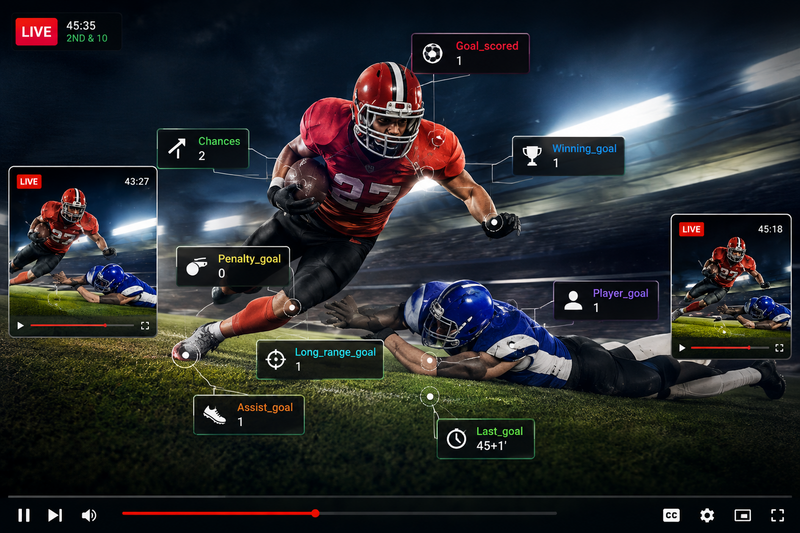
The introduction of in-play or live betting has added a new dimension to the betting experience. In this sector, advanced sports data given in real-time is critical. To alter odds dynamically, betting businesses use real-time data on game progress, player performance, and numerous in-game variables. This kind of reactivity enables customers to interact with the game as it unfolds, making bets on ever-changing events and adding to the excitement of live sports betting.
How do sports betting companies gather such data?
As we already discussed by relying on more accurate and up-to-date sports data, one can apply data-driven insights to improve the accuracy of forecasts in sports betting. But how do companies collect such data?
Sports betting data sources include sports media websites and even sports betting data providers. But while collecting data, companies need to keep in mind that the data is reliable, accurate, and comprehensive. This data may even include detailed stats about the team, player performance, game records, and weather-related data as well.
Thus betting companies need a viable sports data solution that can help them enhance user engagement and this is where Data Sports Group stands out as the preferred choice. Betting organizations seek a dependable and comprehensive sports betting solution in the ever-changing field of sports betting. As the dependence on accurate and fast data is crucial, matched with our commitment to accuracy and a depth of expertise in supplying detailed stats for numerous sports like as football, cricket, rugby, and more any betting company would benefit from our partnership.
As we offer a varied range of data feeds covering major athletic events across the world, and our commitment to precision guarantees that betting firms can make better decisions, offer correct odds and give customers a seamless and entertaining betting experience. As the betting industry evolves, you will be better equipped to deal with the market's complexities and increase your prospects of long-term profitability.