Data analytics in sports is a new buzzword, and numerous teams are working on it to understand the data in the sports world and then use it in the right way. Business analytics provide insight and actionable results that can be leveraged to improve decision making in all aspects of the organization’s operations, including operational performance management, operational effectiveness, quality management, and compliance management. Data Science is concerned with the design, analysis, and application of data to better understand and provide insight to end-users or business owners and improve business outcomes, especially those related to performance management.
Analytics allows businesses to understand better, predict, and optimize their customers’ behaviour based on their unique preferences, expectations, and needs. As a result, analytics has the power to improve customer service, cut down on wasted time, and drive competitive advantage.
The Era of Data-driven Sports Businesses
 The sports data are not yet mature enough for commercial impact in real life or more extensive data science activities. In the present era, the use of data in sports is still in its infancy compared to how it can develop. Data science is still used mainly for prediction, estimation and data integration. However, it is making a significant impact on the current day problems with player health status, the development of athletes and the performance improvement of the sport. Thus, the trend is going in the right direction.
By understanding business processes and their impact on the organization’s mission and objectives, the sports business models use data to find a solution to a business problem and enable insights to support the business decision. One can only speculate as to what input data the models are driving the business problem with and how, but it is likely that the model is driven by analytics on the play and player data.
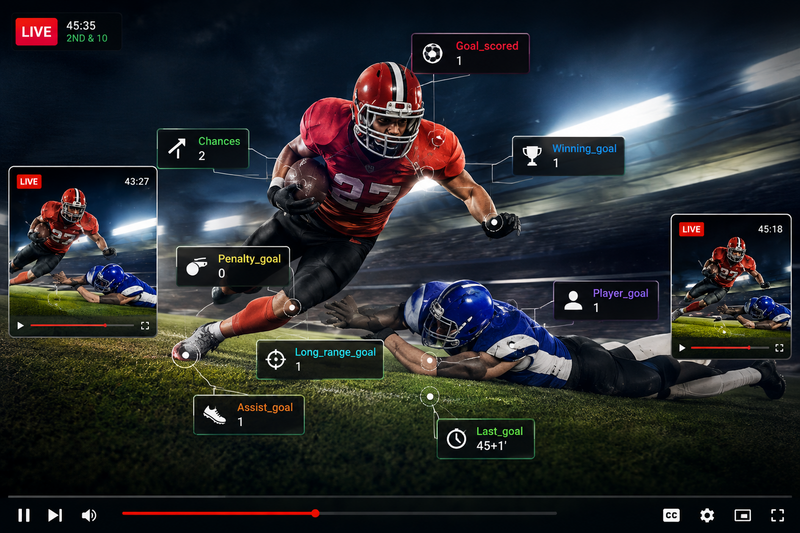
The analytics that drives player performance has implications beyond players themselves, whether they can influence a team’s competitive level or impact on how other players play the game or the competition. For those sports that require a holistic approach, data analytics using a distributed database management system is a powerful tool used to make sense of complex information sources such as satellite video, player attributes, score and performance data, and even fan activity data from match-to-match viewing. In addition, the tool allows for a consistent view of all aspects of match-day business, resulting in efficient, actionable insights.
 The data warehouse is an essential piece of analysis for various highly competitive sports. For instance, in Soccer, the data required during an investigation for Premier Leagues, Championships or NFL where several clubs are associated can be obtained via these analytical methods providing important information about the overall performance of the club, the club hierarchy, the business processes within the club, and the general club environment. However, the use of analytics to provide a competitive edge to existing businesses i59-s highly unlikely unless there is a strong commitment from the sports enterprise to apply analytics to their business processes to improve operational efficiencies and reduce cost. Data-driven businesses require a high level of data collection and storage to ensure proper use of the collected data and provide relevant and actionable results.
How is Sports Business Analytics today?
Big Data is the future of big business and the next generation of Sports and refers to a wide range of data that organizations or individuals create for a variety of legitimate purposes. Sports business analytics encompasses the knowledge, processes, tools and services required for game success. In the past, relying on players with unique skill sets, intelligence, and tactical thinking ability to increase the chances of winning was a common practice. These players also generally had more years of experience which allowed them to improve their tactical thinking more effectively. Nowadays, it is easier to identify players than the data, and in the case of a match, it is easier to find the opponent than the players.
Modern tactics of data-driven sports businesses over various sports like football, basketball, Formula 1 racing and many more include multiple strategies, ranging from the strategic development of brand identity and player development to product development to sales and marketing. In addition to the traditional brand or product development, the player has the option to make personal, confidential or professional decisions on marketing and player behaviour based on the information gathered from data collection and analyses. The data collected includes player demographics, player preferences and behaviours, and player emotions. The objective is to maximize the benefits of the sport for the player by optimizing their individual and collective health as well as team health. If the health is a function of fitness, then the athlete should be monitored to find out if any changes are required, and if necessary, to adjust the training routine accordingly.
For many sports, the goal is to have at least one person perform at or below his or her absolute maximum level of performance. There is usually a rule or norm that defines this level of performance in sport, and that is generally a limit. Data Sports Group is a data-driven sports business attracting significant attention and excellent investment from several players. The success and agility the sports clubs have achieved as part of this clientship only means that data is becoming a strategic asset, an integral part of an integrated business and a strategic priority for the industry. When we consider the future of sports businesses and partnership, it is necessary that we choose the right one.